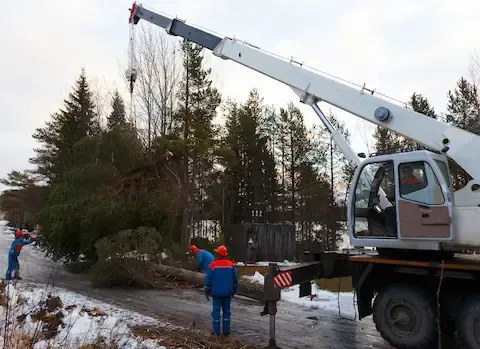
Winter Crane Tree Removal Planning Carol Stream IL
Most homeowners in Carol Stream think spring or summer is the best time to schedule large tree removals. The reality is that winter — specifically the stretch from December through early March — often gives crews the most favorable working conditions for crane-assisted jobs on DuPage County properties. Frozen ground, bare canopies, and predictable scheduling windows combine to make cold-weather removal not just practical, but genuinely advantageous for the property owner.
Why Frozen Ground Changes Everything for Crane Work
A crane outrigger pad distributes significant weight across a concentrated footprint. On a warm, saturated lawn, that load compresses soil, collapses root zones, and leaves ruts that take an entire growing season to recover. When Carol Stream temperatures drop and the ground freezes solid — which happens reliably from late December through February — that same soil becomes structurally firm. Outrigger pads seat cleanly, the crane sits level without settling, and when the equipment leaves, the lawn underneath looks essentially undisturbed.
This matters especially in established neighborhoods where mature oaks, elms, and silver maples grow close to landscaping, irrigation lines, and hardscaping that took years and real money to install. The frozen-ground window protects all of it.
Visibility Advantages of a Bare Canopy
Deciduous trees in Carol Stream drop their foliage by late October. That bare canopy gives the crane operator and the ground crew an unobstructed view of every major limb, structural attachment, and co-dominant stem from the moment they arrive on site. During summer removals, crews work through a dense leaf canopy that obscures branch unions and weight distribution — conditions that slow rigging decisions and increase the number of lifts needed.
A winter removal on a large white oak or silver maple moves faster because the structure is completely visible. The crew can plan each pick sequence before the first cut, sequence the lifts efficiently, and reduce total time on the job. Less crane time means lower operational cost, and that savings is frequently passed to the homeowner.
Scheduling Realities in DuPage County Winters
Tree care companies operating in the Carol Stream area are consistently busier from April through October than they are in winter. Spring storm cleanup, summer aesthetic trimming, and fall crown work keep crews fully booked. By contrast, December and January often carry shorter backlogs. If you contact a crew in November for a January removal, you are far more likely to get your preferred date, a consistent crew assignment, and priority rescheduling if weather delays the original window.
That flexibility matters for crane jobs specifically. Crane rentals are scheduled on specific days, and a crew that is juggling a full summer calendar has less room to accommodate rescheduling if conditions shift. A winter booking carries more scheduling breathing room for everyone involved.
Which Trees Benefit Most from Winter Crane Removal
Not every tree removal requires a crane, but certain situations make crane use the safest and most efficient option regardless of season. In Carol Stream, those situations most often involve:
- Large oaks, silver maples, or cottonwoods over 60 feet tall where aerial rigging alone cannot manage piece weight safely
- Trees leaning toward a structure, fence line, or neighboring property where directional control during the lift is non-negotiable
- Tight rear-yard situations where a bucket truck cannot access but a crane positioned at the property edge can reach over obstacles
- Trees with significant decay at the base or major scaffold limbs, where climbing poses elevated risk
For all of these scenarios, winter timing compounds the advantage. The crew gains ground protection from frozen soil and visibility from the bare canopy simultaneously.
What to Expect During a Winter Crane Removal
A well-organized winter crane removal in Carol Stream typically follows a predictable sequence. The crane arrives and sets up at the street or driveway edge while the arborist crew establishes a work zone. The climber ascends to begin rigging attachment points on the upper sections of the tree. The crane operator takes picks in sequence — usually crown sections first, then major scaffold limbs, then the trunk in sections — lowering each piece to the ground crew who process it for chipping or log cutting.
Throughout this process, Tree Removal by an experienced crew means the coordination between climber and crane operator drives everything. Communication is constant. Each pick is confirmed before the cut is made, and the load path — the arc the lifted piece will travel through the air — is planned to avoid structures, utility lines, and adjacent trees.
Stump grinding typically follows on the same day or is scheduled shortly after. In winter, frozen soil around the stump base can slightly slow the grinder, but the tradeoff is minimal compared to the overall site protection benefits the season provides.
Common Misconceptions About Winter Tree Work
Some Carol Stream homeowners assume that cold weather creates brittle wood conditions that make removal more dangerous. For crane work, this concern is largely unfounded. The crane controls load path and weight management — the structural integrity of the individual pieces being removed is less critical than it would be during a felling operation where a hinge cut must behave predictably. Cold temperatures do not meaningfully change how a crane-rigged section performs during a controlled lift.
Another misconception is that crews are less available in winter because they are not working. The opposite is typically true. Crews are working through the winter on exactly these kinds of planned removals, and they are often more focused and less rushed than during the high-demand spring and summer months.
Planning Your Winter Removal in Carol Stream
If you have a large tree on your DuPage County property that you have been deferring — a declining silver maple near the house, an old cottonwood threatening the fence line, or a storm-damaged oak that needs to come down safely — the November-through-January window is the time to make contact and get on the schedule. You can also read more about the large tree crane process to understand how these jobs are planned and executed from start to finish.
Frozen ground, a visible canopy, and scheduling availability all work in your favor. The property protection benefits alone make winter crane removal worth planning for rather than waiting until spring when conditions and calendars are both more congested.
