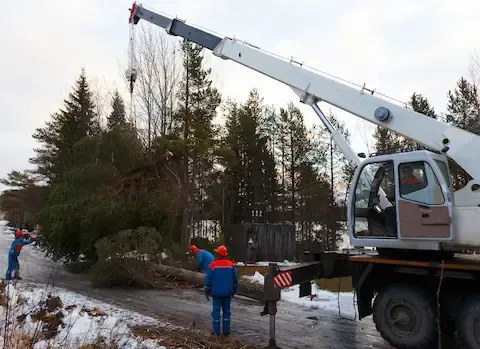
When Crane Tree Removal Saves Carol Stream Property
Not every tree removal job is the same. Some trees stand in open yards with clear sightlines and easy access for a climbing crew. Others have grown over decades into positions that make conventional removal genuinely risky — leaning over a garage, pressed against a fence line, or rooted in a backyard with no equipment access from the street. In Carol Stream and the surrounding DuPage County communities, those second situations are more common than many property owners expect, especially in established neighborhoods where mature trees and tight lots are the norm. Knowing when a crane is the right tool — and when it is not — can protect your property and your budget.
What Crane Tree Removal Actually Involves
Crane tree removal is a method where a large hydraulic crane is positioned near the work site, and a trained arborist rigged with the crane's hook ascends the tree or works from an aerial vantage point to section the tree and lower each piece in a controlled path. Instead of letting sections fall to the ground, the crane carries them out of tight spaces and deposits them in a staging area — typically a street, driveway, or open lawn — where a ground crew can process them.
The method requires a specialized crew, more staging space for the crane itself, and careful pre-job planning. It is not the fastest or cheapest approach for every tree. But for specific conditions, it is the only method that allows safe removal without risking structural damage to everything around the tree.
Trees That Lean Over Structures
In Carol Stream, many mature oaks, silver maples, and cottonwoods have grown for forty or fifty years in the same yard. When they were planted — or when they seeded themselves naturally — the structures around them were either smaller or did not yet exist. Over time, the tree's canopy has spread over rooflines, decks, sheds, and HVAC equipment.
When a tree like this needs removal, the standard approach of topping from the top and letting sections fall into the yard is not viable. The canopy is directly above something you cannot afford to damage. A crane gives the rigging crew the ability to lift each section straight up and out before it ever has a chance to swing toward a shingle roof or an air conditioning unit. That vertical lift capability is what separates crane work from conventional climbing in these situations.
Limited Ground Access and Tight Lot Conditions
Some Carol Stream properties, particularly in older subdivisions near Gary Avenue or in the neighborhoods surrounding Klein Creek, have tree locations that are essentially landlocked from an equipment standpoint. A backyard tree that can only be reached through a narrow gate or a gap between two houses presents a serious obstacle to ground equipment. Bucket trucks and chippers often cannot reach the work site without tearing up landscaping or damaging a fence in the process.
A crane positioned on the street or in the driveway can reach over a house and into a backyard, lifting pieces out the way they cannot travel any other direction. For homeowners with mature trees tucked behind fencing or surrounded by established garden beds, this approach means the yard's landscaping survives the job intact rather than being sacrificed as an equipment path.
Hazard Trees and Compromised Root Systems
Tree hazards are not always visible. A silver maple with a hollow trunk, a storm-damaged oak with a cracked main crotch, or a tree showing signs of root rot near its base may be structurally unstable in ways that make climbing dangerous for an arborist and unpredictable for a ground crew. When a tree's structural integrity is in question, controlling the removal from the outside — using crane rigging rather than relying on the tree itself to hold a climber's weight — becomes a safety priority.
DuPage County sees a significant number of these hazard removals after major storm seasons. Trees weakened by ice loading or high winds may remain upright but have hidden failure points that make conventional removal genuinely dangerous. A crane-assisted approach removes much of that uncertainty by giving the crew external control over how and where each section moves.
When a Crane Is Not Necessary
Understanding when crane removal is the right choice also means understanding when it is not. If your tree stands in an open yard, has no structures beneath its canopy, allows equipment access from the street, and shows no signs of structural compromise, a skilled climbing crew with a chipper and a bucket truck will almost certainly handle the job efficiently and at lower cost. Cranes add mobilization expense and staging requirements that are justified by the conditions they solve — not by tree size alone.
A large tree in a clear, accessible area does not automatically require crane work. What drives the need is the combination of tree position, surrounding structures, access limitations, and tree condition — not diameter at breast height or canopy width in isolation.
What to Expect During a Crane Job in Carol Stream
If your property does qualify for crane removal, the job looks different from a conventional crew arrival. The crane itself is substantial equipment that requires a clear path to its operating position, often a street lane or a wide driveway. In some Carol Stream neighborhoods, this means coordinating with the village for temporary street access or notifying neighbors about equipment positioning.
On the day of the job, the crane operator and the rigging crew work in close communication. The arborist in the tree cuts each section, attaches the rigging, signals the crane operator, and the piece is lifted clear before the cut is completed or immediately after. The pace is deliberate and controlled. A job that might take a ground crew two days to manage conventionally can often be completed in a single day with crane assist because the pieces move efficiently rather than requiring manual repositioning on the ground.
For a full picture of how this process works and whether your specific tree qualifies, review our crane-assisted removal service details before scheduling an estimate.
Protecting Your Property Is the Point
Crane removal is ultimately a property protection decision. The higher mobilization cost of bringing in crane equipment is measured against the cost of repairing a damaged roof, replacing a crushed fence, or restoring a garden that took years to establish. In DuPage County's established neighborhoods, where lots are mature and built-up, that calculation often comes down firmly on the side of the crane.
If you have a large tree in a difficult position and you are trying to determine what approach makes sense, the answer starts with an honest assessment of your specific site conditions — not a general preference for one method over another. Tree Removal planning should always begin with someone walking the property, not with assumptions made from the street.
