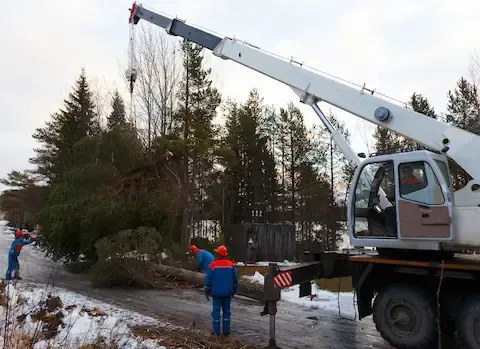
Crane-Assisted Tree Removal in Carol Stream Illinois
When a tree grows too large, too damaged, or too close to a structure for conventional removal methods, crane-assisted work becomes the only practical solution. In Carol Stream and across DuPage County, mature oaks, silver maples, and cottonwoods frequently reach heights and diameters that make ground-based rigging dangerous or simply impossible. Crane-assisted tree removal addresses those situations directly — bringing down massive trees in controlled segments without destroying surrounding landscaping, damaging fences, or threatening nearby structures. Understanding when this method is required, how the process works, and what to expect from start to finish helps you make an informed decision for your property.
What Makes Crane-Assisted Removal Different From Standard Tree Work
Conventional tree removal relies on a climber ascending the tree, cutting sections from the top down, and lowering each piece with ropes. That system works well for trees with good structural integrity, adequate clearance, and firm limb attachment points. When those conditions do not exist — because the tree is dead, because it leans over a roof, or because the canopy spans a fence line, pool, or neighboring yard — the conventional approach becomes unpredictable and risky.
Crane-assisted removal replaces ground-based rigging with overhead mechanical lift. A climber still cuts sections at the top, but instead of relying on rope tension managed from below, each section is attached to the crane's load line. The crane operator lifts the cut piece clear of any obstruction and swings it to an open staging area. This gives the crew precise control over where each piece lands, eliminates the danger of a dropped section damaging a structure, and dramatically reduces the physical labor involved in managing large wood.
The result is a cleaner, faster, and safer operation for trees that would otherwise present serious risk through conventional means.
Situations That Typically Require a Crane in Carol Stream
Carol Stream is a developed suburban community with mature tree canopies, tight residential lots, and a significant number of structures built close together. Several common conditions make crane removal the appropriate choice here.
- Dead or structurally compromised trees: A dead tree provides no reliable anchor points for climbing ropes. Bark slips, limb stubs fail, and the entire structure may be internally rotted. Cranes allow the crew to work from outside the tree, attaching load lines before cuts are made.
- Trees over structures: When a large oak or maple has grown directly over a roofline, sunroom, or attached garage, there is no safe drop zone for conventional rigging. The crane lifts each section vertically and clears it before it can fall.
- Storm-damaged trees: DuPage County storm events frequently leave partially uprooted trees or heavily split canopies that are unpredictable under load. A crane stabilizes the tree during removal rather than relying on the damaged structure to hold tension.
- Very large specimens: Mature silver maples, cottonwoods, and white oaks commonly found on older Carol Stream properties can exceed eighty or ninety feet in height with trunk diameters over four feet. The sheer weight of individual sections makes crane work the only realistic method for controlled removal.
- Confined access yards: When a tree is surrounded by fencing, outbuildings, hardscape, or adjacent plantings that cannot be disturbed, there is no room to let sections drop to the ground. The crane removes wood without any of it ever touching the ground in restricted areas.
How the Process Works from Setup to Cleanup
A crane removal involves more coordination and pre-planning than standard tree work. Here is what the process looks like from the initial assessment through final cleanup.
Site Assessment and Planning
Before any equipment is scheduled, an arborist evaluates the tree's condition, height, estimated weight, and the access points available. In Carol Stream, this often means walking the property to identify underground utilities, assess driveway load capacity, and determine the best crane position. The crane must be able to reach the top of the tree while positioned on stable ground or pavement that can support the equipment's footprint.
Permitting and Utility Coordination
Depending on the location and size of the project, Carol Stream may require a permit for crane operation or tree removal. Your crew should handle any required notifications and coordinate with utility companies when aerial lines are in proximity to the work zone. This step is not optional — it protects you legally and ensures the operation is conducted within local ordinance.
Crew Setup and Equipment Positioning
On the day of removal, the crane is positioned and outriggers are deployed to stabilize the machine. A ground crew establishes a clear staging area where cut sections will be lowered. Depending on yard configuration, wood may be moved immediately or staged temporarily on a tarp or open lawn section away from the house.
Sectional Removal
The climber ascends using ropes independent of the tree itself wherever possible, or uses the crane basket in cases where the tree cannot be safely climbed. Starting at the top, each section is rigged to the load line, cut, and lifted clear. The crane operator and climber communicate constantly throughout this phase. Sections are lowered to the ground crew, who manage the wood into a chipper or cut it to manageable lengths for hauling.
Stump Handling
The final step on removal day is cutting the trunk to grade. Stump grinding is typically scheduled separately or on the same day depending on equipment access. If you're comparing stump removal options afterward, reviewing the differences between grinding versus chemical removal can help you choose the right follow-up method for your yard.
Cleanup and Site Restoration
A full crane removal crew handles wood chipping, debris hauling, and general site cleanup as part of the job. The staging area is raked, and any tire tracks or ground disturbance from the crane are addressed before the crew leaves. Carol Stream homeowners should expect the site to be returned to a clean, usable condition the same day.
Equipment Used in Crane Tree Removal
The crane itself is typically a hydraulic truck crane rated for the lifting capacity required by the job. A forty-ton crane handles most residential work, though larger specimens or complex reaches may require higher-rated equipment. The key specifications are lift capacity at radius — meaning how much weight the crane can safely hold at the horizontal distance from the truck to the tree.
Beyond the crane, the crew uses rigging hardware including load-rated shackles, slings, and chokers specifically designed for arborist work. Standard construction rigging is not appropriate for tree work because the load behavior is different. Proper arborist rigging hardware is rated and inspected before each use.
Chippers used in conjunction with crane removal are typically high-capacity drum or disc chippers capable of handling large-diameter wood quickly. This keeps the staging area clear during a job that can produce a large volume of material in a short time.
Common Misconceptions About Crane Tree Removal
Several misunderstandings come up regularly when homeowners first encounter crane-assisted work.
It costs far more than standard removal. Crane work does involve additional equipment cost, but the efficiency gains offset much of that difference on large trees. A massive oak that would take a ground crew multiple days to dismantle with conventional rigging might be completely down in a single morning with a crane. On the right job, crane work can actually be more cost-competitive than you expect.
The crane will damage the yard. Modern crane trucks have rubber-tracked or rubber-tired configurations and use outrigger pads to distribute weight across the ground. While ground disturbance is possible on very soft or saturated soil, an experienced crew assesses these conditions before positioning equipment. On solid driveways or firm ground, damage is minimal.
Any tree company can do crane work. Crane-assisted removal requires trained operators, proper rigging knowledge, and specific equipment certifications. It is not a service that every tree company offers or is equipped to perform safely. When evaluating providers, confirm that the operator holds appropriate crane certifications and that the company carries the insurance coverage required for crane operations in DuPage County.
Cranes are only needed for the tallest trees. Height is one factor, but location and condition matter more. A sixty-foot tree in an open field may be easy to remove conventionally. A forty-five-foot dead elm directly over a sunroom in a Carol Stream backyard may require a crane to remove safely regardless of its height.
Local Considerations Specific to DuPage County
DuPage County's older residential neighborhoods — including significant portions of Carol Stream — contain trees planted decades ago that have grown well beyond what the original landscaping plan anticipated. Municipal right-of-way trees, trees bordering property lines, and trees that have grown into or above utility easements all present coordination challenges that are handled differently than a tree standing alone on private property.
Carol Stream's public works and forestry departments maintain jurisdiction over parkway trees and any work within the right-of-way. If a tree requiring crane removal sits in or adjacent to the parkway, permits and coordination with the village are required before work begins. Failing to obtain proper clearance can result in fines or stop-work orders even when the removal itself is technically justified.
DuPage County soil conditions, particularly in areas with clay-heavy subsoil, can affect how crane equipment is staged during wet periods. Late winter and early spring removals — common in Carol Stream when tree work crews address storm damage from the previous season — require careful equipment placement to avoid ground disturbance in saturated conditions.
For Tree Removal projects of any scale in the Carol Stream area, working with a crew familiar with local permit requirements, utility coordination processes, and DuPage County conditions makes a material difference in how smoothly the job proceeds.
Evaluating Whether Your Tree Requires Crane Removal
The clearest indicator that crane removal is necessary is when a site assessment reveals that no safe drop zone exists for conventional rigging. If the tree is dead, over a structure, or in a confined yard with no clearance for sections to fall, crane work is the appropriate solution rather than an upgrade.
Other indicators include significant lean toward a structure, visible root upheaval that makes the tree unpredictable under load, evidence of internal decay in a large-diameter trunk, or storm damage that has already compromised the tree's structural integrity.
An experienced arborist can assess these conditions and give you a clear explanation of why crane removal is or is not necessary for your specific situation. If the recommendation is for crane-assisted work, you should receive a detailed explanation of how the equipment will be positioned, how access will be managed, and what the cleanup process will include. Any professional crew operating in Carol Stream or broader DuPage County should be able to walk you through every phase of the job before work begins.
