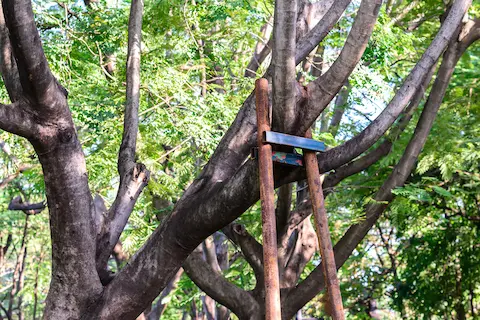
Synthetic vs Steel Tree Cable in Carol Stream Yards
Carol Stream's mature tree canopy — the sprawling silver maples along Gary Avenue, the aging oaks lining residential cul-de-sacs, the co-dominant ash and elm survivors scattered across DuPage County yards — represents decades of shade, property value, and character that no nursery stock can replace quickly. When those trees develop structural weaknesses, cabling becomes the practical alternative to removal. But not all cabling systems are the same, and the choice between synthetic Cobra-style cables and traditional steel cables matters more than most homeowners realize. Understanding the difference before work begins helps you ask better questions and make smarter decisions about trees you've invested years in keeping.
What Makes These Two Systems Fundamentally Different
Steel cable has been the industry standard for tree bracing for most of the twentieth century. It is exactly what it sounds like: a steel wire rope, typically galvanized, threaded through the canopy and anchored with hardware bolted or eye-lag screwed through the branch union. Steel cable is rigid under load. When a limb moves, the cable arrests that movement almost immediately, providing a hard stop. That rigidity made it the go-to solution for decades, and it still has legitimate applications in certain situations.
Synthetic Cobra cable — along with comparable high-strength polyethylene systems — works on a different mechanical principle. These cables are designed with a small amount of controlled elasticity. When a heavy limb sways in wind, the synthetic cable allows a brief, limited range of movement before it resists. That controlled flex is not a weakness. It is the core design feature. The theory, supported by arboricultural research over the past two decades, is that allowing a tree to move within a safe range actually preserves the natural stress-wood formation inside the trunk and limbs. Trees that cannot flex at all can lose the internal taper and density that make wood strong over time.
How DuPage County Wind and Ice Loading Affects the Choice
Carol Stream and the broader DuPage County area experiences a specific climate stress pattern that should factor into every bracing decision. The region sees significant late-winter ice events — the kind that coat every branch with half an inch of glass — combined with summer thunderstorm derecho wind events that can hit sustained gusts well above fifty miles per hour. In either scenario, the cable system in your tree is working hard.
Under ice load specifically, the difference between steel and synthetic becomes pronounced. A steel cable system under extreme ice load transfers stress directly and abruptly to the hardware anchor points. If the ice load exceeds what those anchor points can handle, something gives — sometimes the hardware, sometimes the wood around it. A synthetic system absorbs a portion of that shock load through its controlled elongation, which distributes stress more gradually. For the large, mature silver maples and multi-stemmed oaks common in Carol Stream neighborhoods, that shock absorption is a meaningful advantage in a region with real winter ice risk.
When Steel Cable Still Makes Sense
Steel cable is not obsolete, and a qualified arborist in Carol Stream will still recommend it in specific scenarios. Trees with extremely acute-angled codominant stems — where two nearly vertical trunks share a narrow, included bark union — sometimes need the hard stop that only steel provides. If the geometry of the failure is such that even limited movement creates unacceptable risk, steel's rigidity is an asset rather than a drawback.
Steel also remains common in situations where budget is a primary constraint and the installation needs to serve as a temporary measure while longer-term decisions are made about the tree's future. Steel hardware costs less upfront and the system is simpler to install in certain applications. However, steel cable requires more consistent monitoring for corrosion, hardware fatigue, and the girdling effect that can occur as the tree grows around anchor hardware over years. For long-term installations on trees with decades of life ahead, that ongoing maintenance cost often offsets the initial savings.
Installation Differences That Affect Carol Stream Trees
Synthetic cable systems like Cobra use a different anchoring approach than traditional steel. Rather than hardware threaded through the branch, synthetic systems typically use slings or attachment points positioned around the branch exterior. This matters because every penetration of a tree's vascular tissue is a wound, and wounds in older trees heal more slowly and incompletely. Reducing hardware penetration points — especially on mature oaks and maples already showing stress from the region's compacted clay soils — reduces the infection risk at anchor sites.
The positioning of the cable in the canopy also differs by system. Steel cable installations follow traditional recommendations of placing the cable at roughly two-thirds of the distance between the crotch and the branch tips. Synthetic systems are sometimes installed lower in the canopy because the controlled flex characteristics change the load dynamics. This is a decision that belongs to a certified arborist who can read the specific tree geometry — not a general rule you should apply yourself.
If you are weighing your options for a mature tree on your Carol Stream property, Tree Bracing from a credentialed local arborist is worth scheduling before the next storm season rather than after a failure occurs.
Common Misconceptions About Tree Cabling in Residential Yards
The most persistent misconception is that cabling saves a dying tree. It does not. Cabling addresses structural weakness in an otherwise healthy or stable tree. If a tree in a DuPage County yard is declining from disease, root damage from construction, or girdling root problems — common in the clay soils throughout Carol Stream — adding a cable system does not change that underlying trajectory. The candidate for cabling is a structurally compromised tree with otherwise viable health and longevity.
A second misconception is that once a cable is installed, the tree requires no further attention. Both steel and synthetic systems require periodic inspection. Hardware corrodes. Synthetic webbing can degrade under prolonged UV exposure. The tree itself grows and changes, which can alter how the cable loads. Most ISA-certified arborists in the Carol Stream area recommend annual or biannual visual checks and a full hardware inspection every three to five years depending on system type and tree growth rate.
A third misunderstanding involves the idea that cabling is a permanent solution. For many trees, cabling buys time and reduces risk while the tree continues a natural decline. For others — the structurally sound maple with one co-dominant stem that needs mechanical support — it genuinely can be a decades-long solution. Knowing which category your tree falls into requires an honest assessment from someone who has seen the tree in person.
Making the Decision for Your Property
For most residential situations in Carol Stream and surrounding DuPage County communities, synthetic Cobra-style cable represents the better long-term investment when dealing with mature shade trees showing early structural risk. The reduced hardware penetration, the shock-absorbing flex that suits regional ice and wind events, and the lower long-term maintenance burden align with the realities of aging tree canopies in a suburban Illinois landscape. For more complex situations, particularly acute-angled included bark unions or trees requiring temporary support, steel remains a valid option that your arborist may recommend based on the specific geometry.
Before any cabling work, understanding split-trunk situations is worth reviewing — saving a split trunk tree covers the conditions where bracing decisions become especially time-sensitive. Getting an assessment while the tree is still a candidate for support, rather than after a failure has occurred, is the most important step any Carol Stream homeowner can take for the long-lived trees on their property.
