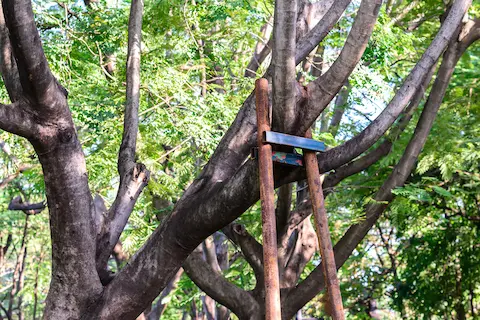
Saving Split Trunk Trees with Bracing Carol Stream
A split trunk is one of the most alarming things a Carol Stream homeowner can discover after a storm or even on a calm morning with no obvious cause. The wood has separated, the tree looks wounded, and the instinct is either to cut it down immediately or to hope it heals on its own. In many cases, neither of those responses is right. Qualified arborists in DuPage County evaluate split trunk trees regularly and find that a meaningful percentage can be stabilized and preserved through proper bracing — but only when the right conditions are present and the work is done correctly.
What Causes a Trunk to Split in the First Place
Most split trunks in Carol Stream trace back to one of a few recurring causes. Co-dominant stems are the most common structural culprit. These are two or more main stems growing upward from the same point on the trunk, often with a tight V-shaped union between them. Over time, bark becomes embedded between the stems at the union — a condition arborists call included bark — and that union becomes structurally weak. When wind load, ice, or even the tree's own weight stresses that junction, the stems can peel apart.
Storm damage accelerates splits that were already developing. Heavy ice in DuPage County winters adds weight that co-dominant stems were never built to handle. Lightning strikes can also cause sudden splitting along the grain. In older trees, decay at the core of the trunk can create an internal void that collapses inward under stress, causing what looks like a spontaneous split from the outside.
Understanding the origin of the split matters because it directly informs whether bracing is appropriate and how the hardware should be positioned.
How Through-Rod Bracing Works
Through-rod bracing is the primary hardware technique used when stems have already separated. Unlike cabling, which connects upper portions of the canopy with high-tension steel or synthetic cable, through-rods are threaded steel rods installed directly through the wood at the split. The rod passes through both stems, and threaded nuts and washers on each side compress the split together and prevent further separation.
Installation requires drilling through living wood, which is a precision process. The rod diameter, placement height, and thread pattern all affect how load is redistributed across the split. Arborists typically combine through-rod bracing with cabling higher in the canopy — the rod holds the split closed at its base while the cable reduces the lateral forces that caused the split in the first place. For more on how cabling integrates with bracing decisions, the article on when to cable a mature tree covers the evaluation criteria arborists use in this area.
The goal is not to restore the tree to its original structure. It is to arrest the failure, stabilize what remains, and allow the tree to compartmentalize the wound over time. Many braced trees in Carol Stream go on to produce new growth that gradually encloses the hardware and reinforces the repaired union.
What Arborists Evaluate Before Installing Bracing
Not every split trunk is a good candidate for bracing. Arborists in Carol Stream look at several factors before recommending hardware installation.
- Extent of the split: A split that has traveled only a few feet up the trunk from the union is far more manageable than one that extends through a large portion of the canopy.
- Wood condition at the split face: Clean, fresh wood that has separated recently is much easier to stabilize than wood that shows signs of decay, fungal staining, or insect activity along the split surface.
- Species characteristics: Some species, including certain oaks and maples common throughout DuPage County, compartmentalize wounds effectively. Others are more prone to continued decay after injury.
- Root zone health: A tree that is already stressed from root compaction, construction damage, or soil issues common in Carol Stream's residential neighborhoods may not have the vitality to respond well to bracing.
- Overall canopy condition: A tree with a full, healthy canopy has more reason to save and more resources to recover. A tree that was already declining before the split presents a different calculation.
When all of these factors align favorably, Tree Bracing provides a legitimate path to preserving a tree that would otherwise need to come down. When the factors are mixed, arborists may recommend a reduced crown to lower wind load before or alongside bracing. When the factors are clearly unfavorable — significant decay, extensive split, or poor vitality — removal is the honest recommendation.
What Happens After Bracing Is Installed
Bracing hardware is not a permanent fix that you install and forget. Trees that have been braced need periodic inspection, typically on an annual or biennial schedule. The tree continues to grow around the hardware, and that growth changes how load is distributed. Rods that were correctly sized at installation may need evaluation as the tree matures. Cables used in conjunction with rods stretch over time and require retensioning or replacement.
Carol Stream homeowners with braced trees should watch for new cracking near the rod installation points, unusual lean developing in the canopy, or any signs of fungal growth along the repaired split. Any of these observations warrants a professional follow-up rather than a wait-and-see approach.
The split trunk itself will never fully "heal" in the way a skin wound heals. Instead, the tree generates callus tissue that rolls inward over the edges of the wound. Given enough time and favorable conditions, this callus can provide meaningful reinforcement — but it supplements the hardware, it does not replace it.
Realistic Expectations for Carol Stream Property Owners
A successfully braced tree in Carol Stream can remain a healthy, safe landscape feature for many years. Some of the most impressive mature trees in DuPage County's older residential areas have been living with bracing systems for decades. But the outcome depends entirely on the quality of the initial assessment, the precision of the installation, and the consistency of follow-up care.
If you have a tree with a split trunk, the worst thing you can do is delay the evaluation. A split that is fresh and the wood is still tight is dramatically easier to stabilize than one that has been open to moisture, insects, and fungal spores for an entire season. The longer the wound remains unaddressed, the narrower the window for a successful bracing outcome.
Getting a professional assessment quickly gives you the information you need to make the right decision — whether that decision is bracing, removal, or a combination of crown reduction and hardware installation. Carol Stream arborists familiar with DuPage County soil conditions and local species performance are best positioned to give you an honest, site-specific answer.
