Emerald Ash Borer Identification in Carol Stream IL
The emerald ash borer (EAB) has become one of the most destructive invasive species threatening ash trees across DuPage County and Carol Stream. This metallic green beetle, first detected in Illinois in 2006, has killed millions of ash trees throughout the Midwest. Early identification of EAB infestation is crucial for saving your trees and preventing the spread to neighboring properties in your Carol Stream neighborhood.
Understanding Emerald Ash Borer Behavior
Adult emerald ash borers are small, metallic green beetles approximately half an inch long. They typically emerge from ash trees between May and September in the Carol Stream area, with peak activity occurring during June and July. The adults feed on ash tree leaves, causing minimal damage compared to their larvae.
The real destruction occurs when female beetles lay eggs in bark crevices. Once hatched, the larvae tunnel beneath the bark, creating serpentine galleries that disrupt the tree's ability to transport water and nutrients. This feeding pattern eventually girdles the tree, leading to branch dieback and eventual death within two to four years of initial infestation.
EAB exclusively targets ash trees, including white ash, green ash, black ash, and blue ash species common throughout Carol Stream landscapes. The beetle shows no preference between healthy and stressed trees, making all ash trees in DuPage County vulnerable to attack.
Canopy Warning Signs
Crown dieback represents one of the earliest visible symptoms of EAB infestation. You'll notice branches in the upper canopy beginning to lose leaves and appear sparse, typically starting from the top of the tree and progressing downward. This dieback pattern differs from other tree diseases because it often begins in the upper third of the crown.
Leaf yellowing and premature leaf drop may occur during the growing season, even when other trees in your Carol Stream yard remain fully leafed. Affected trees may also produce epicormic shoots - small branches growing directly from the trunk or larger branches - as the tree attempts to compensate for dying crown areas.
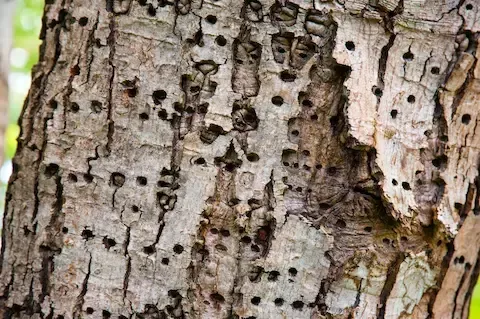
Increased woodpecker activity around ash trees signals potential EAB presence. Woodpeckers actively seek out EAB larvae beneath the bark, creating distinctive rectangular holes and removing patches of bark. If you notice heavy woodpecker damage on ash trees in your DuPage County property, investigate further for other EAB symptoms.
Bark-Level Identification Markers
D-shaped exit holes in the bark serve as definitive proof of EAB presence. These holes, approximately one-eighth inch in diameter, appear when adult beetles emerge from the tree. The distinctive D-shape results from the beetle's flattened body profile and distinguishes EAB from other wood-boring insects that create round exit holes.
Vertical bark splits and cracks often develop over larval galleries as the tree responds to feeding damage. These splits may reveal the characteristic S-shaped or serpentine galleries carved by EAB larvae beneath the bark. Fresh galleries appear light-colored and may contain frass (insect excrement) or sawdust-like material.
Bark peeling or flaking in irregular patches exposes the underlying wood and gallery systems. This symptom typically appears in later stages of infestation when significant larval feeding has compromised bark integrity. Tree Disease Treatment professionals can help assess the extent of damage revealed by bark examination.
Gallery Pattern Recognition
EAB larval galleries create distinctive feeding patterns beneath ash tree bark. These galleries typically run perpendicular to the grain of the wood and follow an S-shaped or serpentine path. The galleries range from one-eighth to one-quarter inch wide and may extend several inches in length.
Fresh galleries appear cream-colored or light brown against the darker sapwood. Older galleries may darken or become stained over time. The galleries often overlap or intersect when infestations are heavy, creating a network of feeding tunnels that effectively girdles branches or trunk sections.
Pupal chambers appear as wider, oval-shaped areas at the end of larval galleries where beetles complete their development before emerging. These chambers are typically packed with frass and may contain pupal skins after adult emergence.
Seasonal Identification Timing
Spring inspection provides optimal conditions for identifying overwintering larvae and fresh pupal chambers. During March and April in Carol Stream, examine ash trees before leaf emergence when bark details remain clearly visible. Look for new bark splits, increased woodpecker activity, and emerging gallery patterns.
Summer months offer opportunities to spot adult beetles and fresh egg-laying sites. Adult EAB beetles are most active during warm, sunny days between late May and early September. Fresh exit holes and increased feeding damage become apparent during this period.
Fall assessment reveals the full extent of current-year damage and helps predict next season's infestation severity. Our tree disease treatment overview explains the importance of timing treatment applications based on seasonal EAB development patterns.
Common Misidentification Issues
Other wood-boring insects can create similar-looking damage, leading to misidentification. Native clearwing borers produce round exit holes rather than D-shaped holes and typically target stressed trees rather than healthy ones. Bronze birch borers affect birch trees exclusively and create different gallery patterns.
Ash yellows disease causes similar crown symptoms but results from a bacterial infection rather than insect feeding. Trees with ash yellows typically show more gradual decline over several years, while EAB damage progresses more rapidly once symptoms appear.
Environmental stressors such as drought, construction damage, or soil compaction can cause crown dieback resembling early EAB symptoms. However, these conditions rarely produce the distinctive bark splits, exit holes, and gallery patterns associated with EAB infestation.
Professional Assessment Benefits
Certified arborists possess specialized training in EAB identification and can distinguish between EAB damage and other tree health issues affecting ash trees in DuPage County. Professional assessment includes detailed bark inspection, gallery pattern analysis, and evaluation of treatment options based on infestation severity.
Early professional intervention significantly improves treatment success rates and may save ash trees that would otherwise require removal. Arborists can also assess nearby ash trees for prevention treatments and develop comprehensive management strategies for properties with multiple ash trees throughout Carol Stream neighborhoods. Emerald ash borer is just one of many threats to local trees - for the broader picture see our full tree disease diagnosis and treatment overview.
