Tree Cabling and Bracing Systems in Carol Stream IL
Large shade trees are one of Carol Stream's most valuable assets — lining streets in Elk Trail subdivision, shading backyards near Armstrong Park, and anchoring decades of neighborhood character along Glen Ellyn Road. But when a mature oak or silver maple develops a weak structural union, or when storm damage splits a codominant stem, homeowners face a difficult choice: remove a tree they've lived with for fifty years, or find a way to preserve it safely. Tree cabling and bracing systems offer a third path — engineered support installed by a certified arborist that extends a tree's functional lifespan while managing the risk of failure. This guide explains how these systems work, when they're appropriate, and what Carol Stream property owners should expect from the process.
What Tree Cabling and Bracing Actually Do
Cabling and bracing are complementary systems, but they address structural weakness in different ways. Cables are flexible steel or synthetic lines installed in the upper crown to limit how far codominant stems or large scaffold limbs can spread apart during wind loading. Bracing rods are threaded steel rods that pass through weak unions or cracked crotches, providing rigid support where the wood itself has lost integrity.
Neither system corrects a structural flaw — they manage it. A tree with a wide-angle codominant stem doesn't become structurally sound after cabling; it becomes less likely to fail catastrophically because the cable absorbs and distributes lateral forces that would otherwise concentrate at the union. That distinction matters for setting realistic expectations. Cabling and bracing preserve trees that have value worth preserving, in locations where failure would cause harm, and where the tree's overall health makes long-term retention reasonable.
In DuPage County, where mature silver maples and green ash have grown for fifty or sixty years in tight urban lots, the cost calculus often favors preservation. Replacing a 24-inch caliper tree means waiting two to three decades for a comparable canopy. A well-installed cable system, maintained on a regular inspection schedule, can add many years to a tree's service life at a fraction of replacement cost.
Tree Structures That Benefit Most From Support Systems
Not every tree needs cabling, and installing hardware in a structurally sound tree adds cost without benefit. Arborists evaluate specific structural conditions when recommending support systems.
Codominant stems with included bark are the most common candidate. When two stems of roughly equal diameter grow from the same origin, bark can become embedded between them rather than forming wood-to-wood contact. The resulting union is mechanically weaker than a single-stem branch attachment. Included bark is common in silver maples, Bradford pears, and older elms — all of which grow extensively across Carol Stream's residential blocks.
Overextended lateral limbs on mature oaks and elms sometimes develop weight distribution that exceeds what the branch attachment can safely carry. This is particularly common after crown cleaning removes interior competition, causing remaining limbs to receive more light and put on additional growth.
Storm-damaged splits where a major stem has partially failed but remains viable. If the cambium is intact and the crown is still producing foliage, a split stem can sometimes be reintegrated using a brace rod and cable combination, though timing and the extent of damage are critical factors.
Trees with sentimental or functional value in specific positions — a tree sheltering the south-facing side of a house from summer sun, or a boundary tree with shared value to adjacent properties — justify more aggressive preservation efforts than a tree that would be easily replaced.
How Cabling Systems Are Installed
Installation follows ANSI A300 standards, which specify cable placement height, hardware specifications, and load calculations. A certified arborist assesses the tree's structure, identifies the stems or limbs requiring support, and determines cable anchor points — typically installed two-thirds of the way up from the union to the branch tips, which provides the leverage needed to limit movement at the problem union below.
Steel cables require hardware anchored through the stem using eye bolts or J-lags. Synthetic high-strength rope systems, which have become more common in recent years, use slings around the stem rather than penetrating hardware — reducing wound potential but requiring more frequent inspection for wear. Both approaches are legitimate; the choice depends on the tree's species, stem diameter, crown architecture, and the arborist's assessment of load requirements.
Brace rod installation requires drilling through both stems at the union, inserting a threaded rod, and securing it with washers and nuts on both sides. The rod must pass through sound wood — decay at the union can make bracing ineffective or impossible. This is why a thorough assessment, sometimes including a resistograph or sonic tomograph for decay detection, precedes any hardware installation.
For Carol Stream residents considering Tree Bracing for a large shade tree on their property, working with a certified arborist who follows ANSI standards ensures the system is properly engineered rather than guessed at.
Ongoing Inspection and Maintenance Requirements
A cabling system is not a one-time fix. Steel cables stretch over time as the tree grows and wind loading cycles the hardware. Hardware can corrode. Synthetic rope systems can abrade where they contact bark. The tree itself continues to grow — stems increase in diameter, union geometry shifts, and the original cable placement may need adjustment.
ANSI A300 guidelines recommend inspection of cable and brace systems at least every two years for steel hardware systems, and annually for synthetic rope systems. In practice, many Carol Stream arborists recommend inspecting cabled trees every year as part of a routine arborist visit — combining system inspection with pruning assessment and overall health evaluation. DuPage County's storm season, with significant thunderstorm activity from late spring through early fall, creates regular high-load events that accelerate hardware wear and make annual inspection practical rather than excessive.
Property owners should also observe cabled trees after major wind events. If a cable appears slack, a hardware component has shifted, or new cracking is visible at the union, an arborist should inspect the system before the next storm season. Early intervention after an unusual load event can prevent secondary failure.
Common Misunderstandings About Cabling and Bracing
Several misconceptions circulate among homeowners that can lead to poor decisions about tree support systems.
Cabling doesn't make a tree safe in all conditions. A properly installed cable limits movement and reduces failure probability — it doesn't eliminate risk. Trees in severe structural decline, with extensive internal decay, or with compromised root systems may pose unacceptable risk regardless of hardware. An honest assessment from a certified arborist may conclude that removal is the safer option, and that conclusion should be respected even when it's not what a homeowner wants to hear.
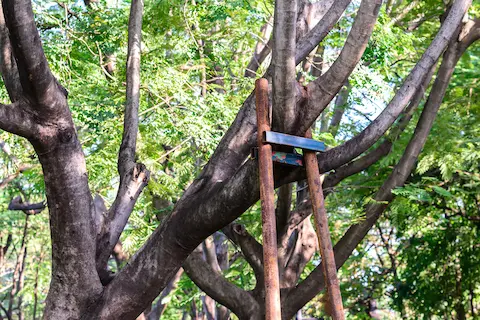
Hardware installed by non-arborists often fails to meet standards. Eye hooks screwed into bark, rope or chain wrapped around stems, and diagonal bracing made from lumber are not substitutes for engineered cable systems. These improvised approaches may appear to provide support while actually concentrating load at the attachment point, girdling bark, or providing inadequate tensile strength. If a previous owner installed hardware of uncertain origin, an arborist should evaluate it before assuming it's functional.
Cabling cannot reverse structural decline from root damage or disease. If the tree is losing structural integrity due to Armillaria root rot, vascular disease, or grade changes that damaged feeder roots — issues that affect many mature trees in Carol Stream's older subdivisions — cabling addresses crown movement but not the underlying cause of structural weakness. Comprehensive tree assessment is necessary before committing to a support system.
Carol Stream Site Conditions That Affect Cabling Decisions
Carol Stream's landscape presents specific conditions that arborists factor into cabling recommendations. The community sits in a transition zone between prairie soils to the west and clay-heavy glacial soils to the east, with soil conditions varying significantly between subdivisions developed at different eras. Clay soils that stay wet through spring can compromise root anchorage in large trees, affecting how much crown support hardware can safely provide.
Overhead utility conflicts affect installation logistics in many Carol Stream neighborhoods. Cabling work on street trees or trees near utility corridors may require coordination with ComEd or the Village's public works department, particularly if aerial lifts need to work within setback distances of energized lines.
The Village of Carol Stream's tree preservation ordinance applies to trees above certain caliper thresholds on residential and commercial properties. Preservation-oriented interventions like cabling generally align with ordinance intent, but property owners undertaking significant tree work should confirm permit requirements with the Village before proceeding. An established local arborist will already understand these local requirements and can advise accordingly.
For context on how structural interventions compare to other tree service costs in the area, reviewing crane tree removal pricing helps illustrate why preservation is often the more economical long-term choice for high-value mature trees.
When Cabling Is the Right Decision
Cabling and bracing make the most sense when a tree has genuine long-term value, the structural issue is limited and well-defined, the tree's overall health supports continued vigor, and the installation can be done to ANSI standards by a qualified arborist. In Carol Stream's established neighborhoods, where mature shade trees contribute measurably to property values and neighborhood identity, those conditions are often met.
The decision should always follow a professional assessment — not a neighbor's recommendation, an online checklist, or a contractor's sales call. A certified arborist evaluates the whole tree: structural issues, health indicators, root zone conditions, target zones below the crown, and the specific forces the support system would need to resist. That assessment tells you whether cabling is genuinely appropriate, or whether other interventions — pruning to reduce sail area, root zone improvements, or in some cases removal — would better serve the tree and the property.
Mature trees in DuPage County take generations to grow. When engineering can extend their safe service life, that's usually worth doing thoughtfully and professionally.
