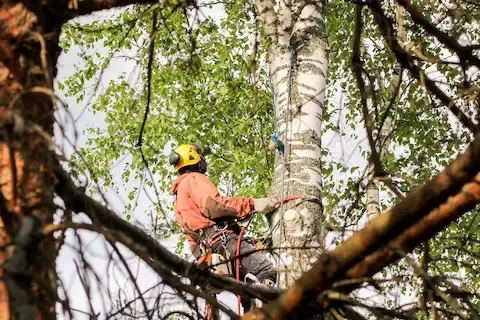
Honeylocust Pruning Schedule for Carol Stream Yards
Honeylocust trees are a common sight in Carol Stream yards and along DuPage County parkways — prized for their feathery canopy, filtered shade, and tolerance of compacted urban soils. But their growth habits also mean they need regular attention to stay safe and looking sharp. Knowing when and how to prune your honeylocust makes a real difference in how the tree responds, how quickly wounds close, and whether you end up encouraging or discouraging the thorny regrowth that can make these trees tricky to manage.
Why Honeylocust Pruning Timing Matters in Carol Stream
Honeylocust (Gleditsia triacanthos) is more forgiving than many other hardwoods when it comes to pruning timing. Unlike oaks — which carry strict dormant-season windows due to oak wilt risk — honeylocust can technically be pruned at almost any point during the year without triggering a serious disease response. That said, late winter remains the preferred window for Carol Stream homeowners and arborists alike, typically from late February through mid-March before bud break.
Pruning during late dormancy offers several practical advantages. The tree's structure is fully visible without leaf cover, which helps with identifying crossing limbs, deadwood, and congested branch unions. Wound compartmentalization begins quickly once spring growth kicks in, meaning cuts made in late February are already healing by April. You also avoid the heat stress of summer cuts and the slower closure rates that come with pruning in fall.
That said, dead or hazardous limbs should always be removed regardless of season. If a storm in July drops a co-dominant stem or creates a hanging branch over your patio in Carol Stream, waiting until February is not the right call.
Understanding Honeylocust Growth Habits in DuPage County
Most honeylocusts planted in DuPage County residential yards are the thornless cultivars — varieties like Gleditsia triacanthos var. inermis — which were developed specifically to reduce the aggressive thorn clusters that make wild honeylocust so difficult to handle. However, even thornless cultivars can occasionally produce thorny root sprouts or reversion growth, especially after heavy pruning near the base or following root disturbance from nearby construction or landscaping work.
Honeylocust also tends toward a naturally open, spreading canopy with fine compound leaves. This means interior thinning is often less critical than it is for denser species like silver maple or Norway maple. What matters more with honeylocust is managing structure — especially in younger trees — and keeping the canopy balanced as the tree matures.
In Carol Stream's urban environment, where many honeylocusts are planted near driveways, patios, and overhead utility lines, clearance pruning is often a routine need. DuPage County's utility corridors also mean that some honeylocusts near rights-of-way may fall under utility company maintenance schedules, which operate independently of homeowner preferences.
A Practical Honeylocust Pruning Schedule for Carol Stream Yards
For most established honeylocusts in residential Carol Stream settings, the following seasonal approach keeps the tree healthy and manageable:
- Late February to mid-March: Primary structural pruning window. Remove deadwood, address co-dominant leaders in younger trees, make clearance cuts over structures, and complete any thinning needed to improve light penetration or reduce wind resistance. This is the best time to make larger cuts because wound wood forms quickly as temperatures rise.
- June (optional light shaping): If the tree pushed vigorous water sprouts in spring — which honeylocust sometimes does after hard pruning — early summer is a reasonable time to remove them before they lignify. Keep cuts small. Avoid removing healthy new foliage that the tree needs for photosynthesis.
- Late October through November: Fall pruning is possible but not ideal. Wound closure slows significantly as the tree heads into dormancy. Reserve fall cuts for deadwood removal and hazard correction rather than elective shaping.
- Any time: Dead, broken, or storm-damaged limbs. Safety always takes priority over schedule.
If you're unsure whether your honeylocust is due for a full structural prune or just minor maintenance, reading up on how often to prune mature trees gives useful guidance on typical intervals for established trees in this region.
Thorn Cuts and Reversion Growth
If your honeylocust is producing thorny shoots — either from the base, along the trunk, or from low lateral branches — those should be removed as early as possible. Thorny reversion growth is most common when the root zone has been disturbed or when the tree has been pruned aggressively. Left unchecked, these shoots can develop into full thorny branches, which complicates future maintenance and creates a safety hazard in yards with children or pets.
When removing thorn-bearing shoots from the trunk or base, cut flush to the parent tissue without leaving stubs. Stubs invite decay and are also more likely to re-sprout. If thorny growth keeps returning from the same location, it may indicate the tree is under stress or that the rootstock is expressing itself — an issue worth discussing with a qualified arborist.
Canopy Thinning Versus Crown Reduction
These two approaches are frequently confused but serve different purposes. Thinning removes individual branches throughout the canopy to improve light and air movement without changing the tree's overall height or spread. Crown reduction shortens the tree's reach, usually to achieve clearance over a structure or reduce the tree's overall load. For honeylocust in Carol Stream residential settings, thinning is the more common need. Crown reduction should be reserved for situations with clear structural justification — not aesthetic preference — and should only be performed using proper reduction cuts that redirect growth to a lateral branch.
Topping — cutting back to stubs without regard for branch structure — is never appropriate for honeylocust or any other shade tree. It creates large exposed wounds that decay rapidly, generates dense regrowth that is weakly attached, and significantly shortens the tree's useful life.
When to Call a Professional for Honeylocust Work in Carol Stream
If your honeylocust has limbs over a roof, near power lines, or larger than three to four inches in diameter, DIY pruning carries real risk. Working at height with a chainsaw or handsaw on branches under tension requires training, proper equipment, and situational awareness that most homeowners don't have on a ladder in the backyard. Professional Tree Trimming services in Carol Stream have the equipment and training to handle mature honeylocusts safely, including in tight urban lots where drop zones are limited.
Annual or biennial inspections by a certified arborist are a reasonable investment for any established shade tree in DuPage County. They keep your tree on a consistent maintenance schedule, catch structural issues before they become hazards, and ensure that pruning work is done in a way that supports the tree's long-term health rather than just addressing immediate aesthetics.
